johan_u

Experiences · DIVE ITS Bali

Two weeks being a foreigner at home

I am Indonesian. I spent a fortnight in Indonesia, on a programme run by an Indonesian university, with a cohort that mostly was not — and the thing I came back with had less to do with the itinerary than with the vantage point. Standing next to people seeing my country for the first time turned out to be the fastest way to find out which of my own assumptions I had never actually examined.

4 – 15 May 2026two weeks, Bali
ITSIndustrial and Systems Engineering
Graded AInnovEnt, credit-bearing
Team of fourGroup Eight

01 · The premise

A country I thought I already knew

Igniting Innovation and Entrepreneurship, at Institut Teknologi Sepuluh Nopember.

The programme was two weeks of business innovation and entrepreneurship teaching at ITS, ending in a pitch to the lecturers and an external panel. It carried credit and a grade, which is worth saying plainly because it changes what the fortnight was: not a field trip with a certificate at the end, but a course with an assessment I could fail.

The part I did not expect

Most of the cohort was seeing Indonesia from the outside. Watching them, I noticed that things I had filed away as ordinary — the scale of the market, what resources are actually available here, which opportunities are simply sitting unclaimed — were being read as significant. I had known all of it as fact. I had never once turned it over and asked what followed from it. Being the local in the room is not the same as having looked.

What I took away

Familiarity is a poor substitute for attention, and it is the more dangerous of the two because it feels like knowledge. I now deliberately look for the person in the room who is seeing the thing for the first time, and ask what they noticed — not to be polite, but because they can see the part I have stopped registering.
The team working around a table during the programme, with a prototype on the desk
Group Eight, mid-week, somewhere between a premise and a pitch.
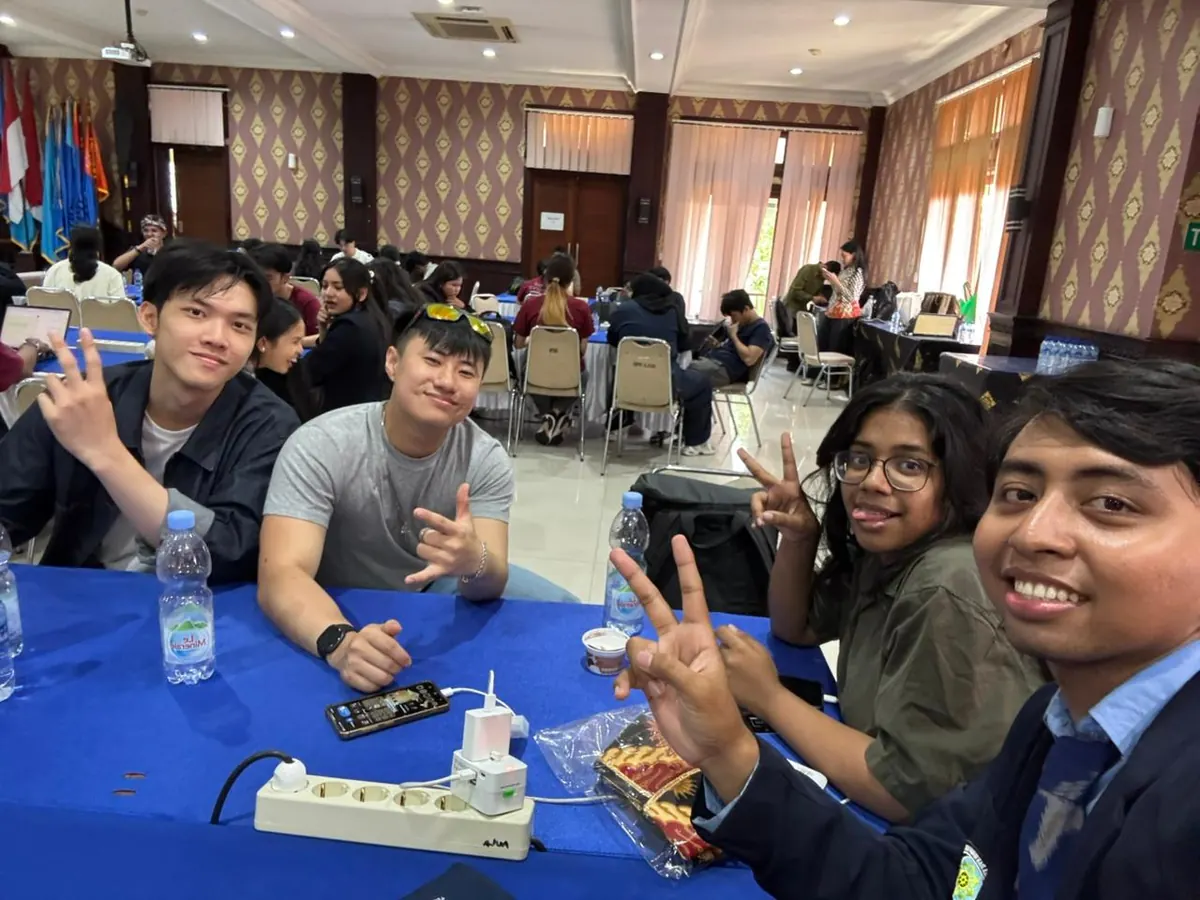
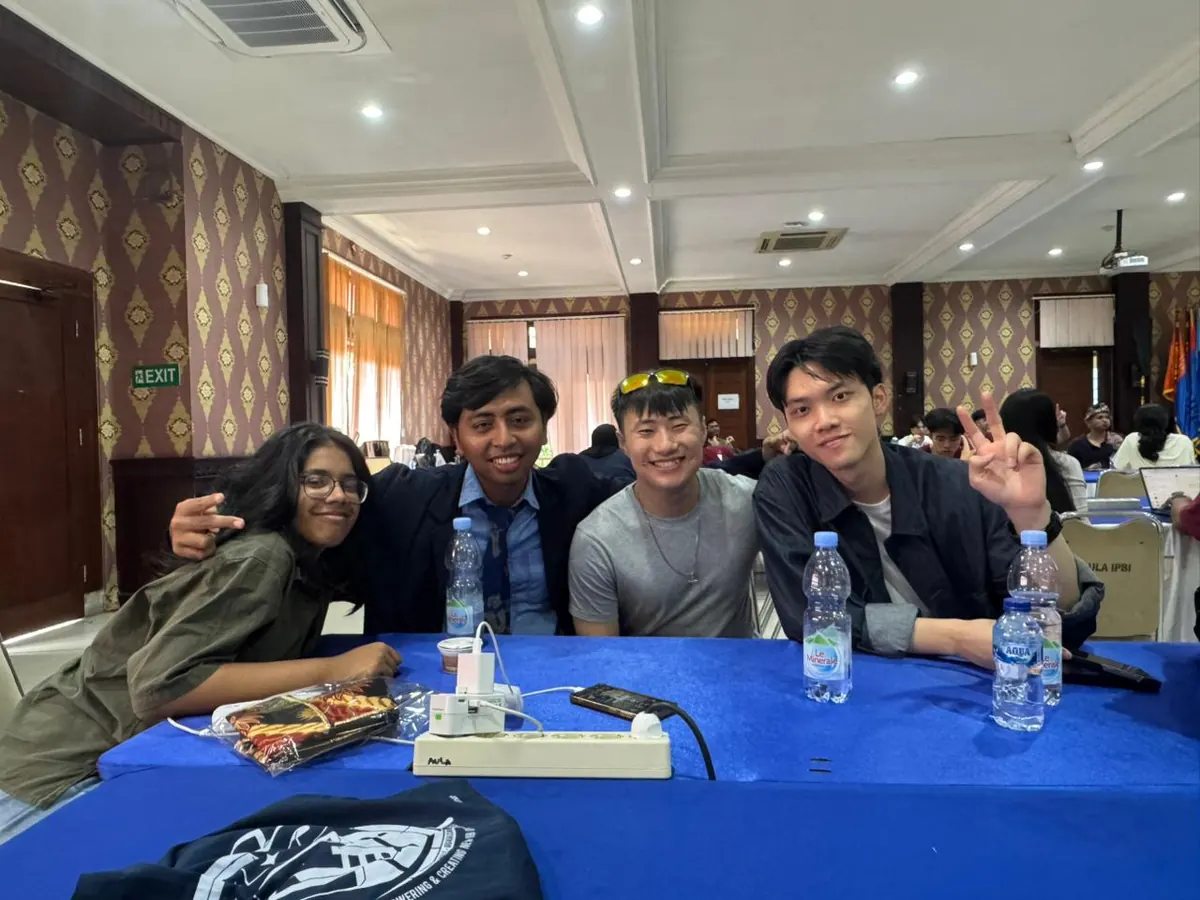
The group gathered around a table in the seminar room between sessions
The rest of the cohort, between sessions.
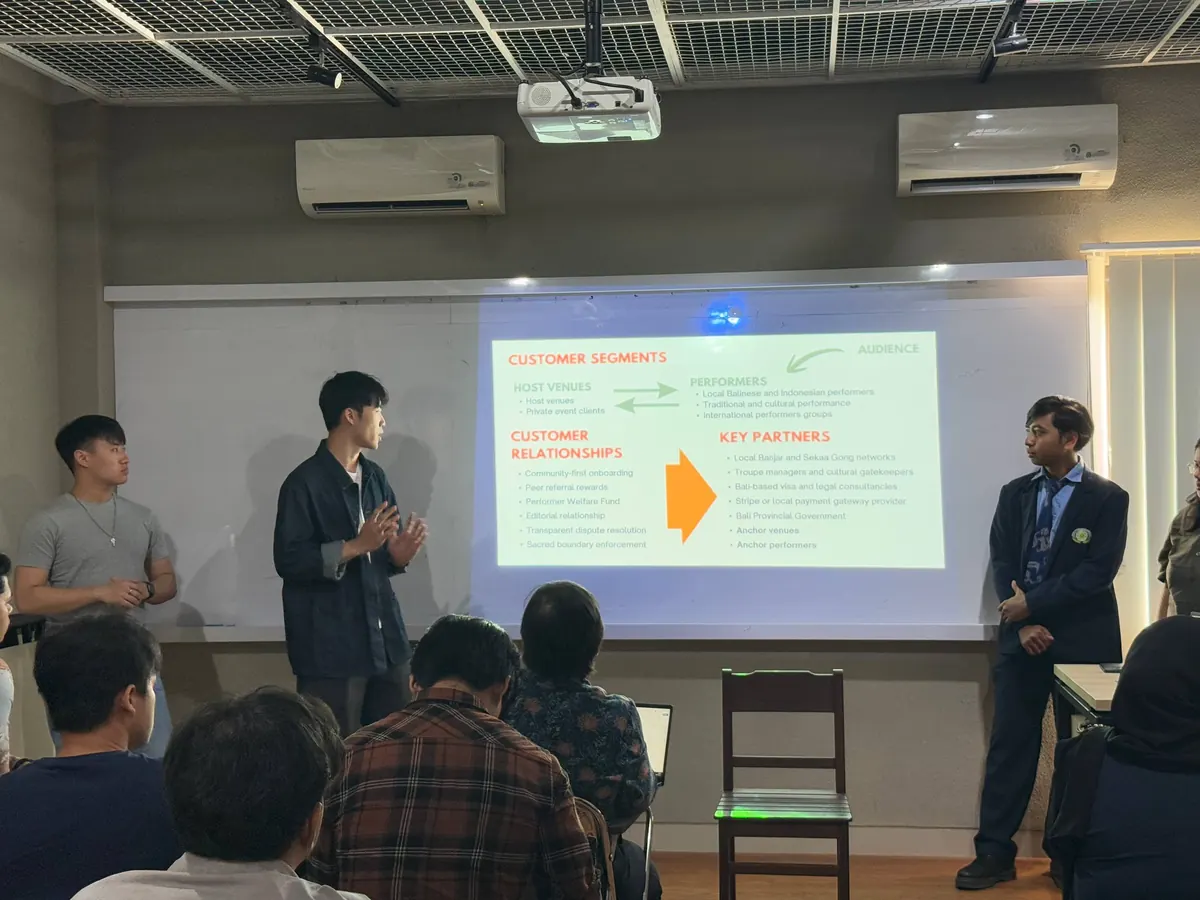
Presenting a business model canvas slide showing customer segments and key partners
Walking the panel through the canvas.
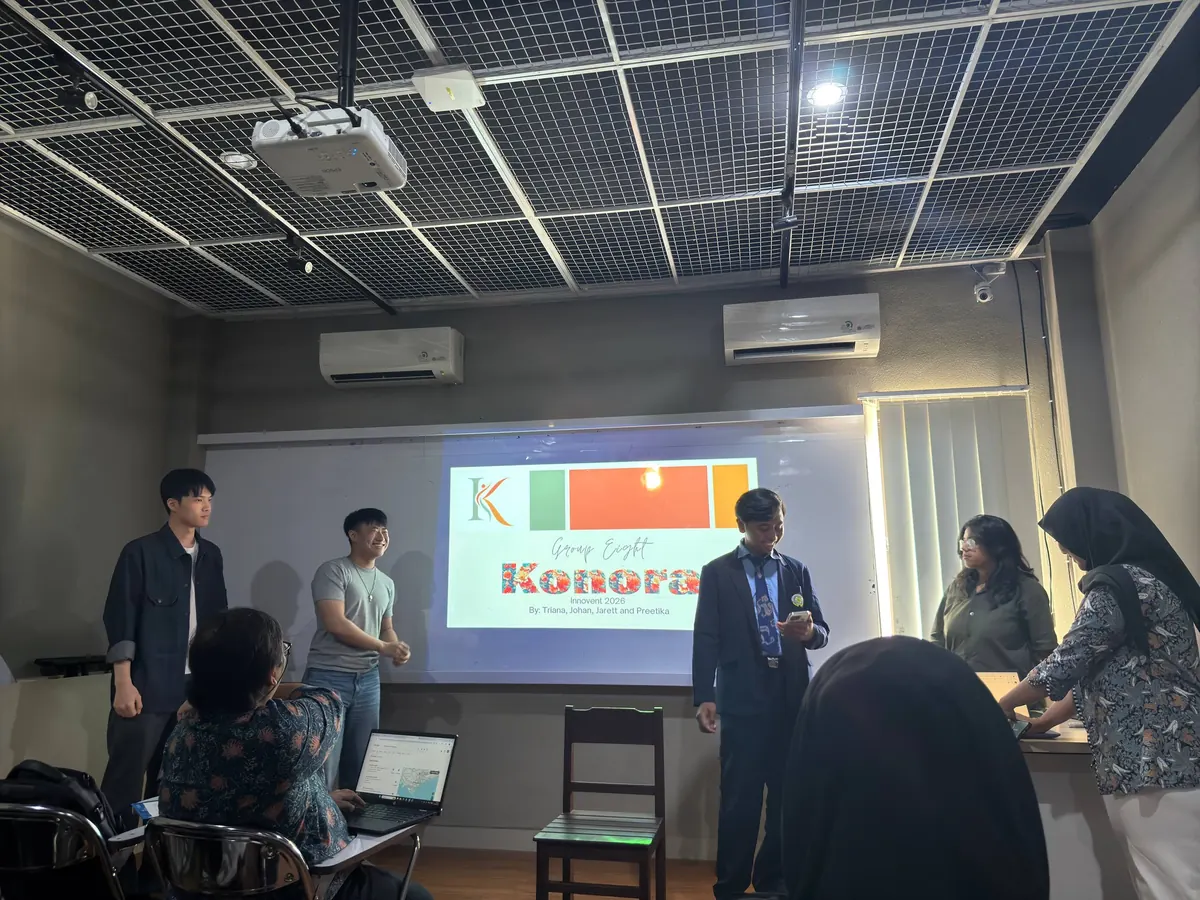
Two of the team standing at the front of the room during a working session
The room where most of the fortnight happened.

02 · The work

Canvas, value chain, and a market that was not broken by accident

The coursework had an output, and the output had to survive questions.

The teaching ran through business model canvases, value-chain analysis and the mechanics of how a firm actually captures the value it creates. The assessment was to take a real market, work out where the money goes and why, and propose something that changed it. Ours was the market for Balinese traditional performers.

What we found

Middlemen were taking thirty to forty per cent of a booking fee to close a gap that a directory would close for nothing. That is not a broken market — it is a market working exactly as designed, for somebody other than the performers. Naming that correctly mattered more than any feature we drew afterwards.

The result was Konora, and because it is a built thing rather than a place I went, it lives with the other projects.

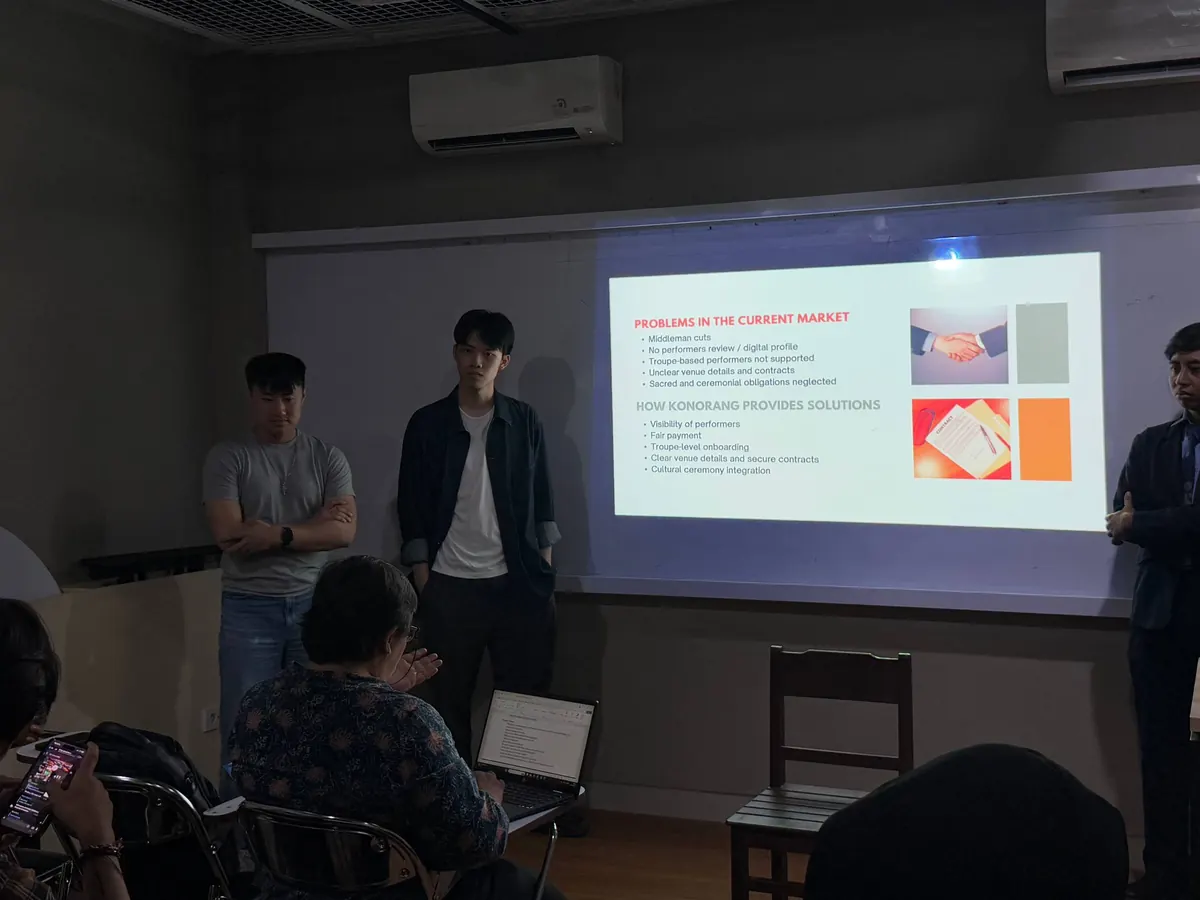
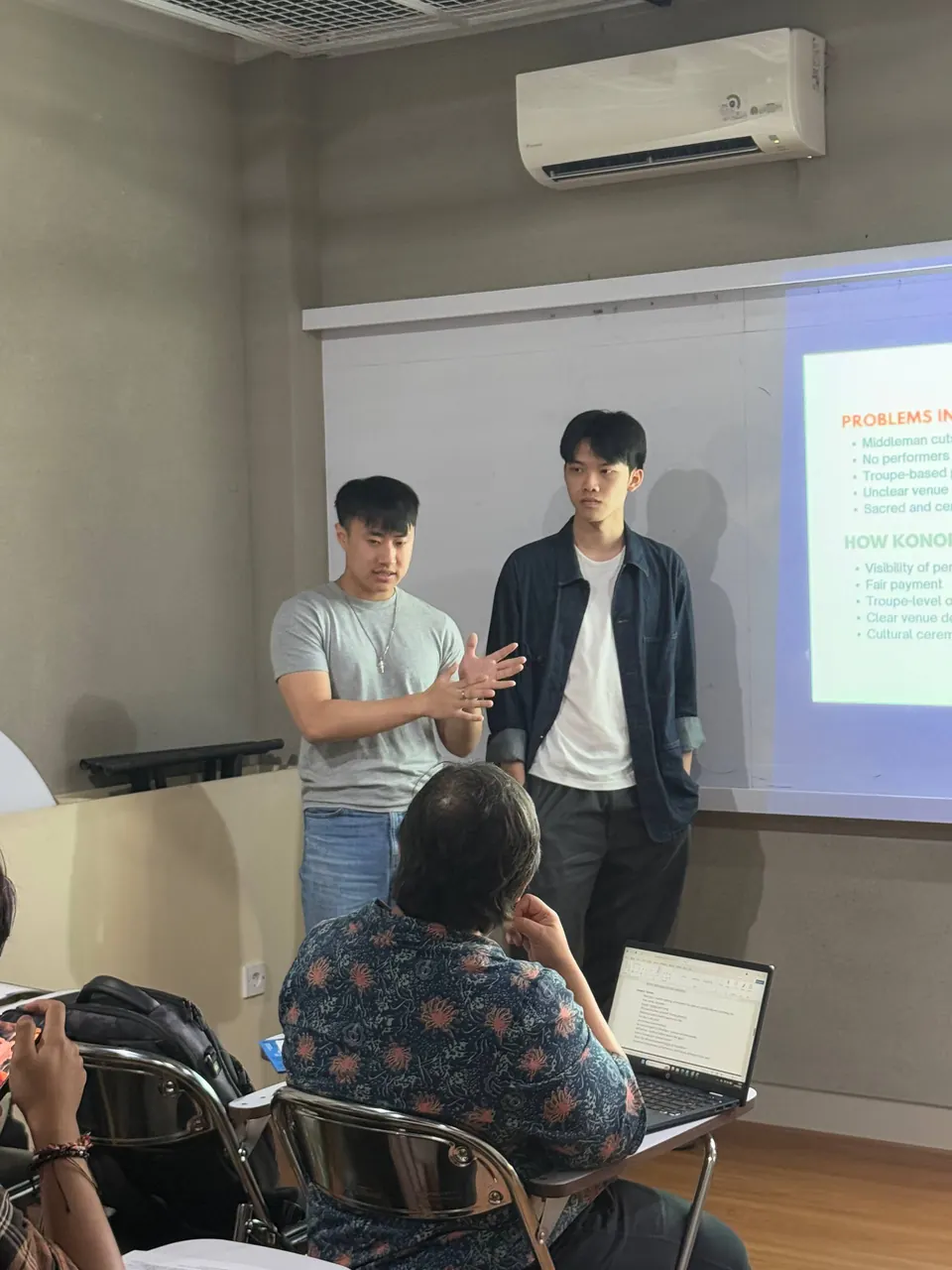
Presenting the slide listing problems in the current market and the solutions proposed
The problem slide: middleman cuts, no performer profile, unclear contracts.
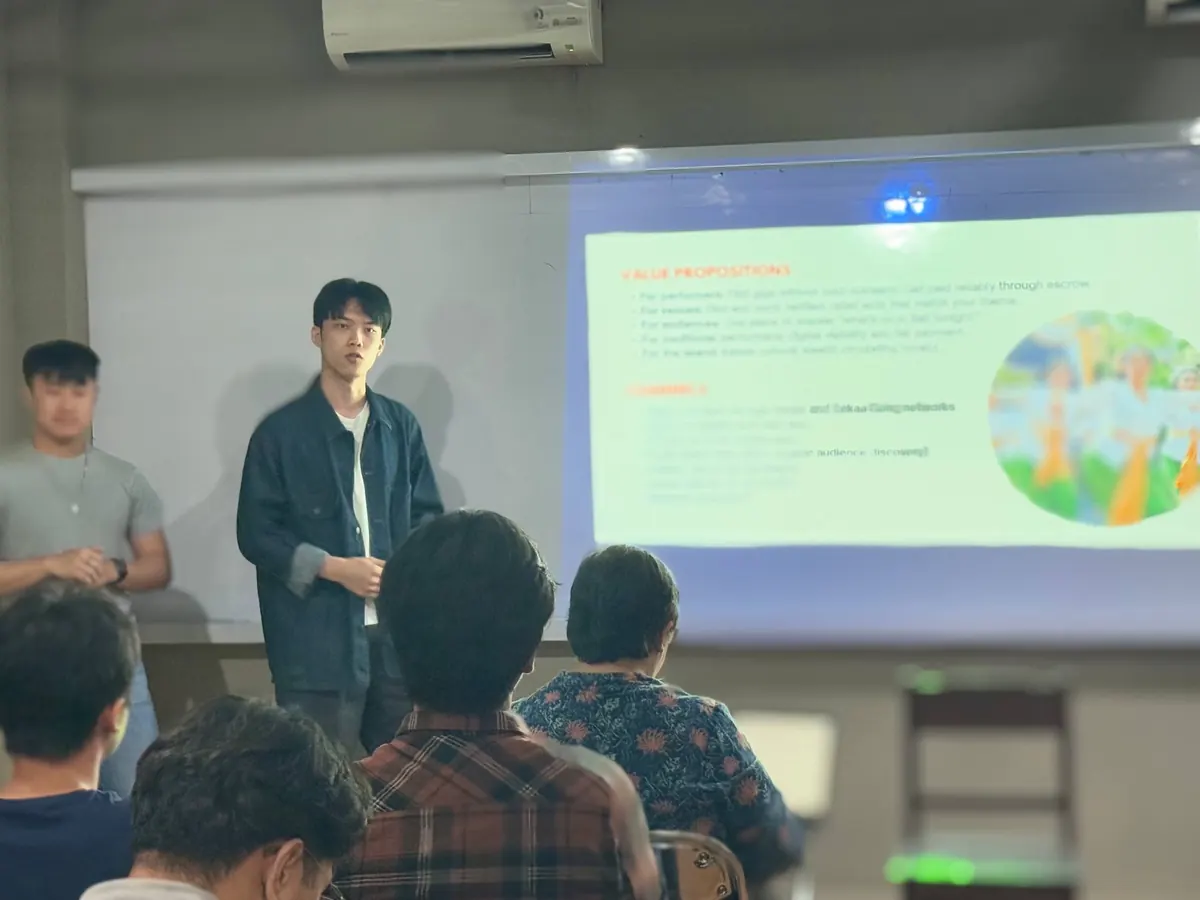
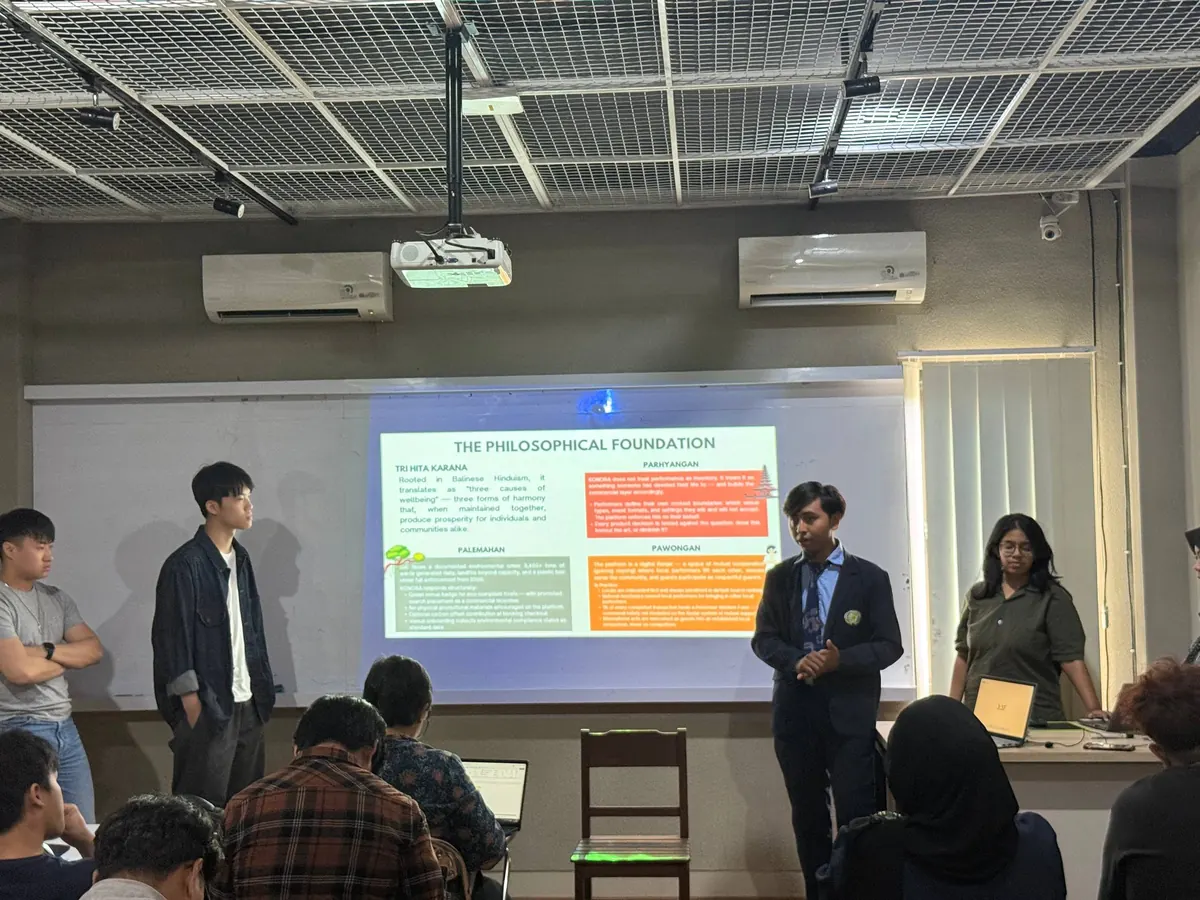
Presenting the philosophical foundation slide to the lecturers and the external panel
Fielding it in front of the lecturers and the external panel.
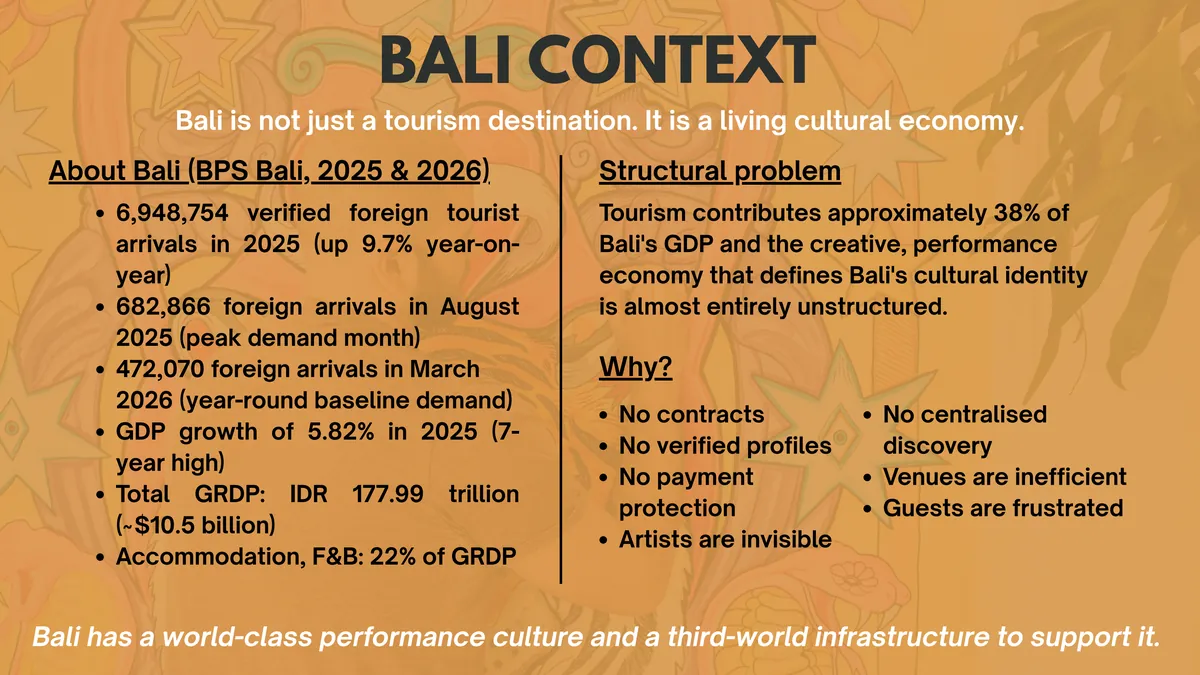
Slide setting out the Bali context from national statistics: foreign arrivals, provincial GDP growth and the share of GDP from tourism
The ground we argued from: 6.9 million foreign arrivals in 2025, tourism around 38 per cent of Bali’s GDP.
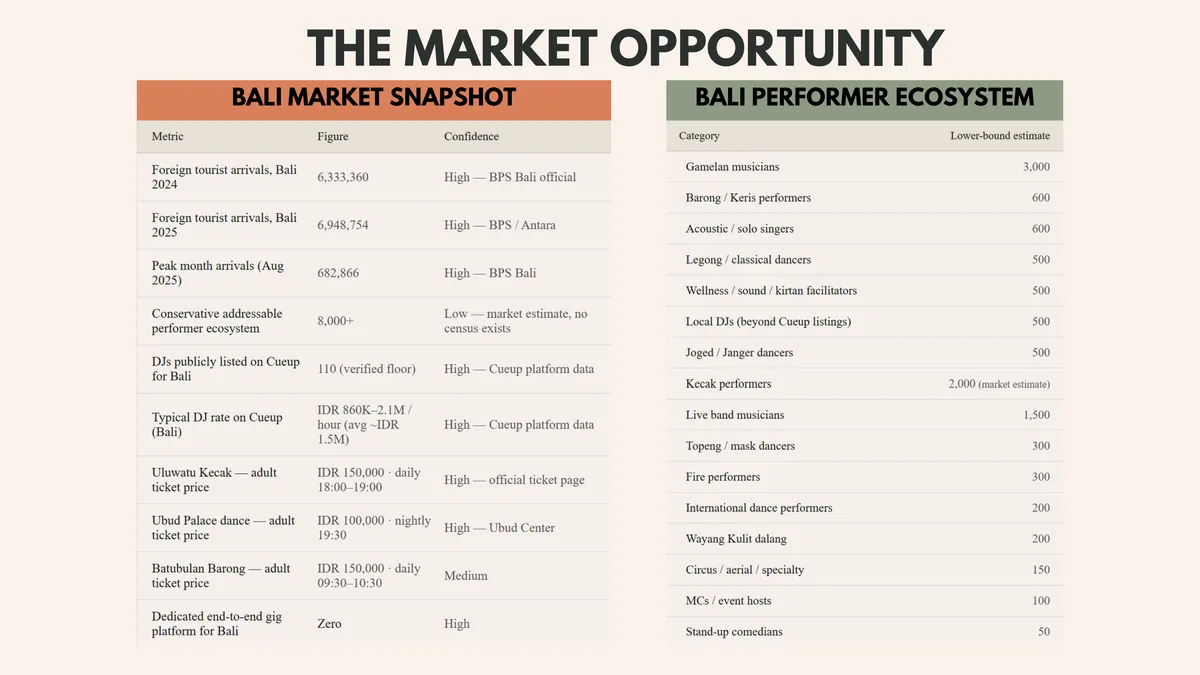
Slide showing the Bali market snapshot and the performer ecosystem, with categories and rates tabulated
And the performer ecosystem itself, counted and priced line by line.

03 · Translation

Working in two languages, in both directions

The job nobody assigns, and the one I turned out to be useful at.

I speak English and Indonesian fluently, so I spent a good deal of the fortnight moving ideas between them. That is less mechanical than it sounds. The hard part was almost never vocabulary — it was that an argument built to persuade an English-speaking room is shaped differently from one built to persuade an Indonesian-speaking room, and a sentence carried across word for word arrives with the wrong emphasis and sometimes the wrong meaning entirely.

Where it got difficult

Western-framed ideas landed awkwardly with my Indonesian groupmates, and their reasoning landed just as awkwardly the other way. So I stopped translating sentences and started translating intent: saying what the person was trying to achieve, then rebuilding the argument in the shape the other side would recognise. Slower, and considerably more accurate.

On disagreement

We had disputes. Every one of them was settled calmly, and not one cost us a working day — which I attribute to my groupmates' patience rather than to any technique of mine. I did learn that most disagreements I assumed were about the decision were actually about somebody not having been heard yet.

What I took away

Being bilingual is not the skill. Knowing that the same argument has to be rebuilt rather than restated is the skill, and it applies just as much between an engineer and a client as between two languages.

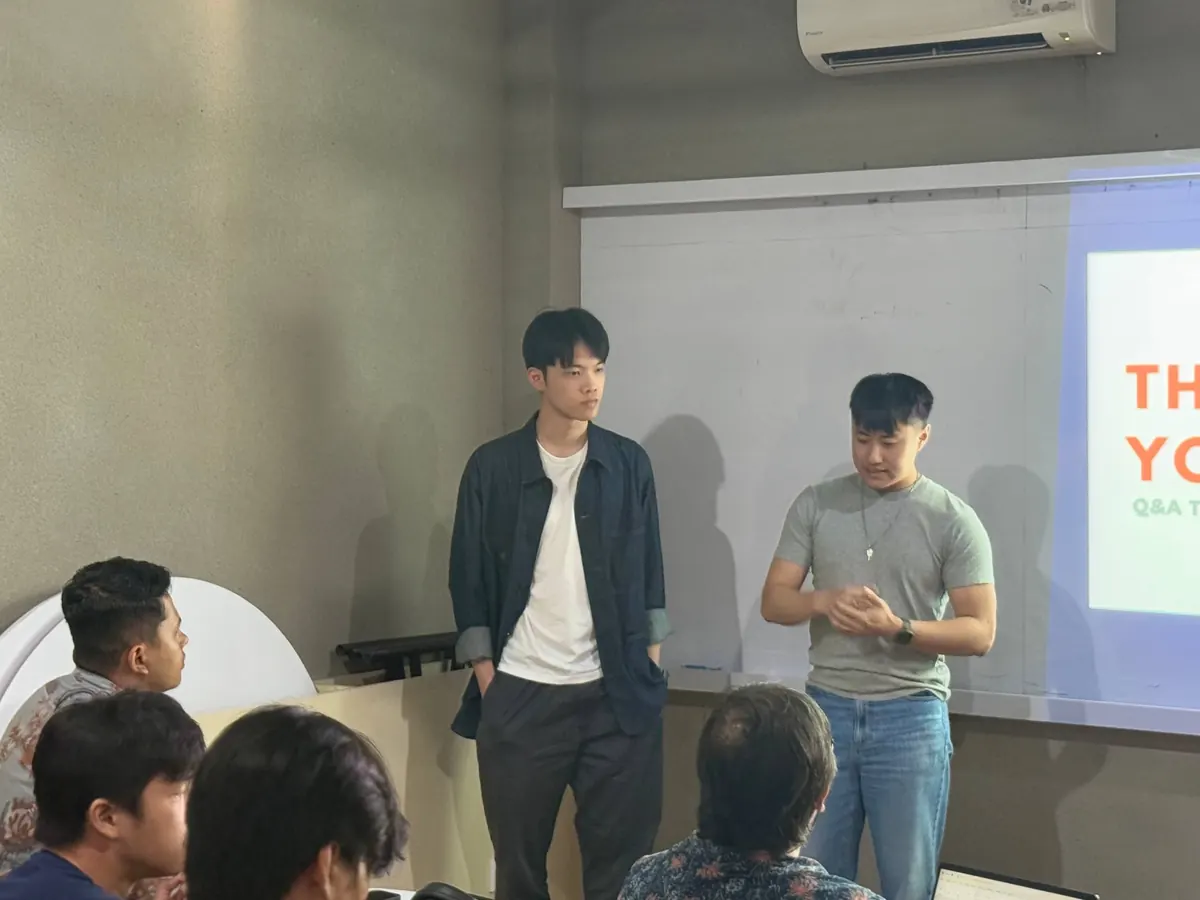
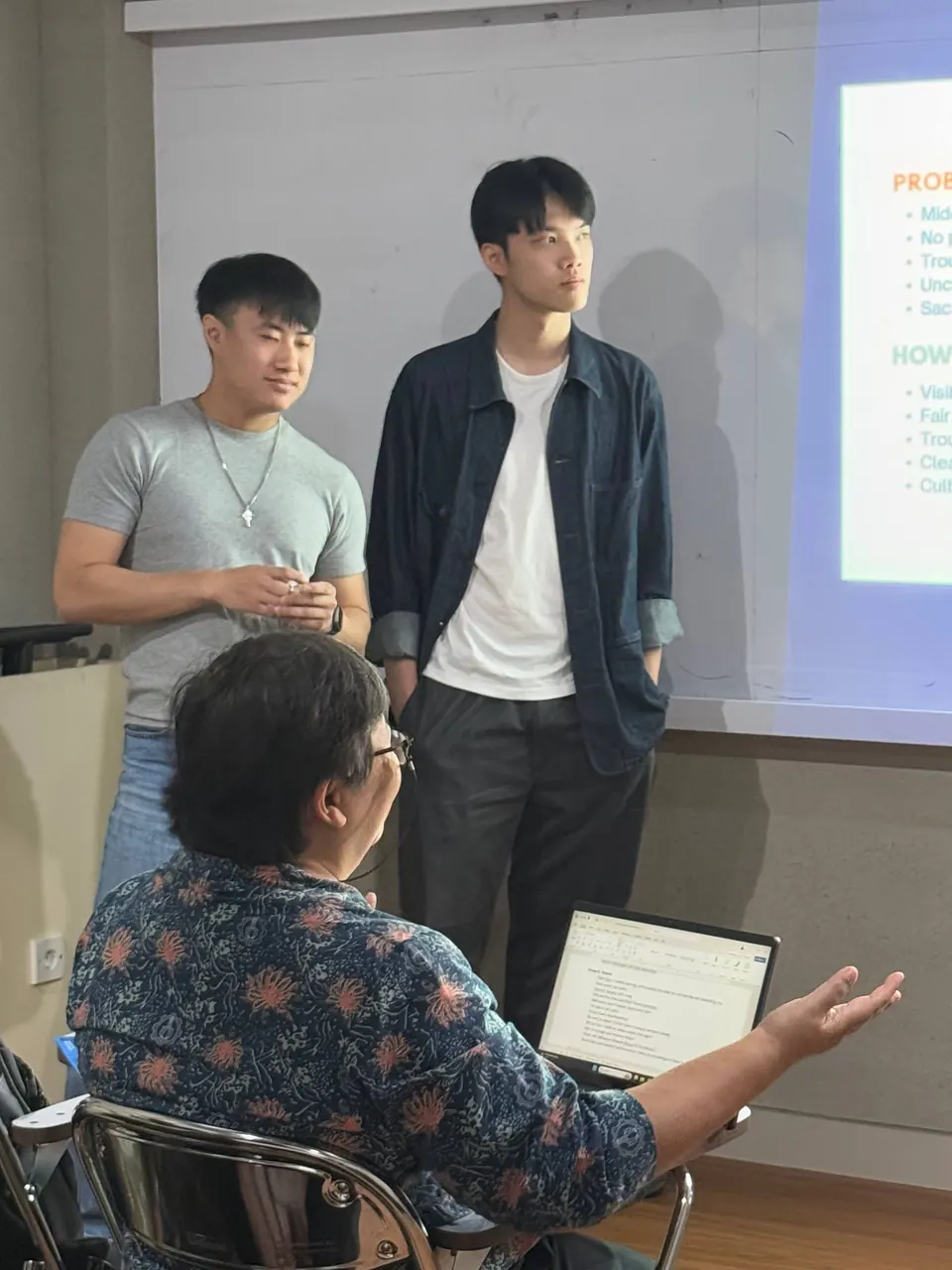
Two of the team standing at the front while a member of the audience puts a question to them
A question coming in from the floor.
Answering a question with both hands open, a raised hand still visible in the foreground
And the answer, which is where the rebuilding actually happens.
The team standing together with the teaching assistant at the end of a session
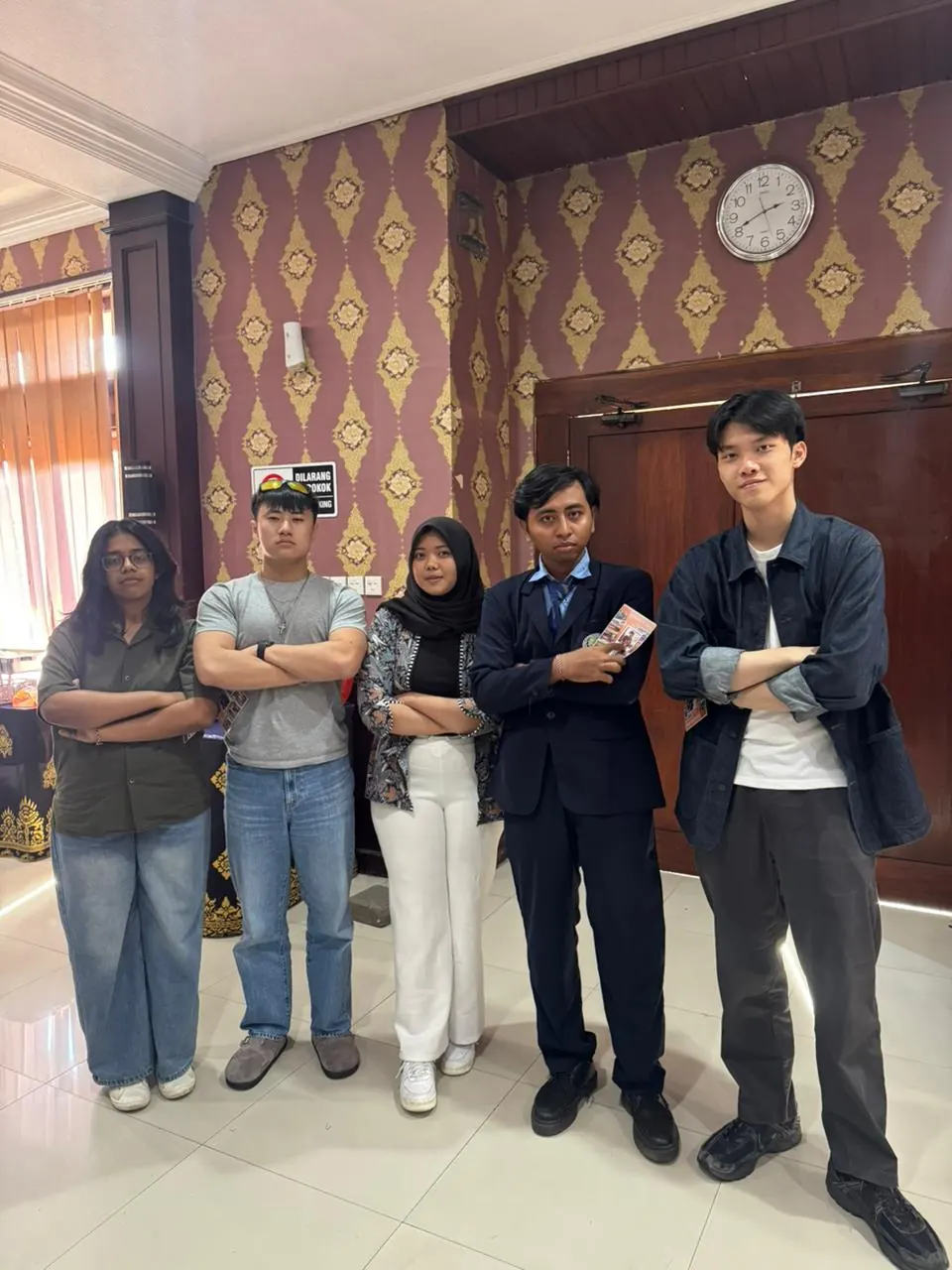
The group I spent a fortnight moving ideas between.
The team on stage at the close of the programme, holding their certificates
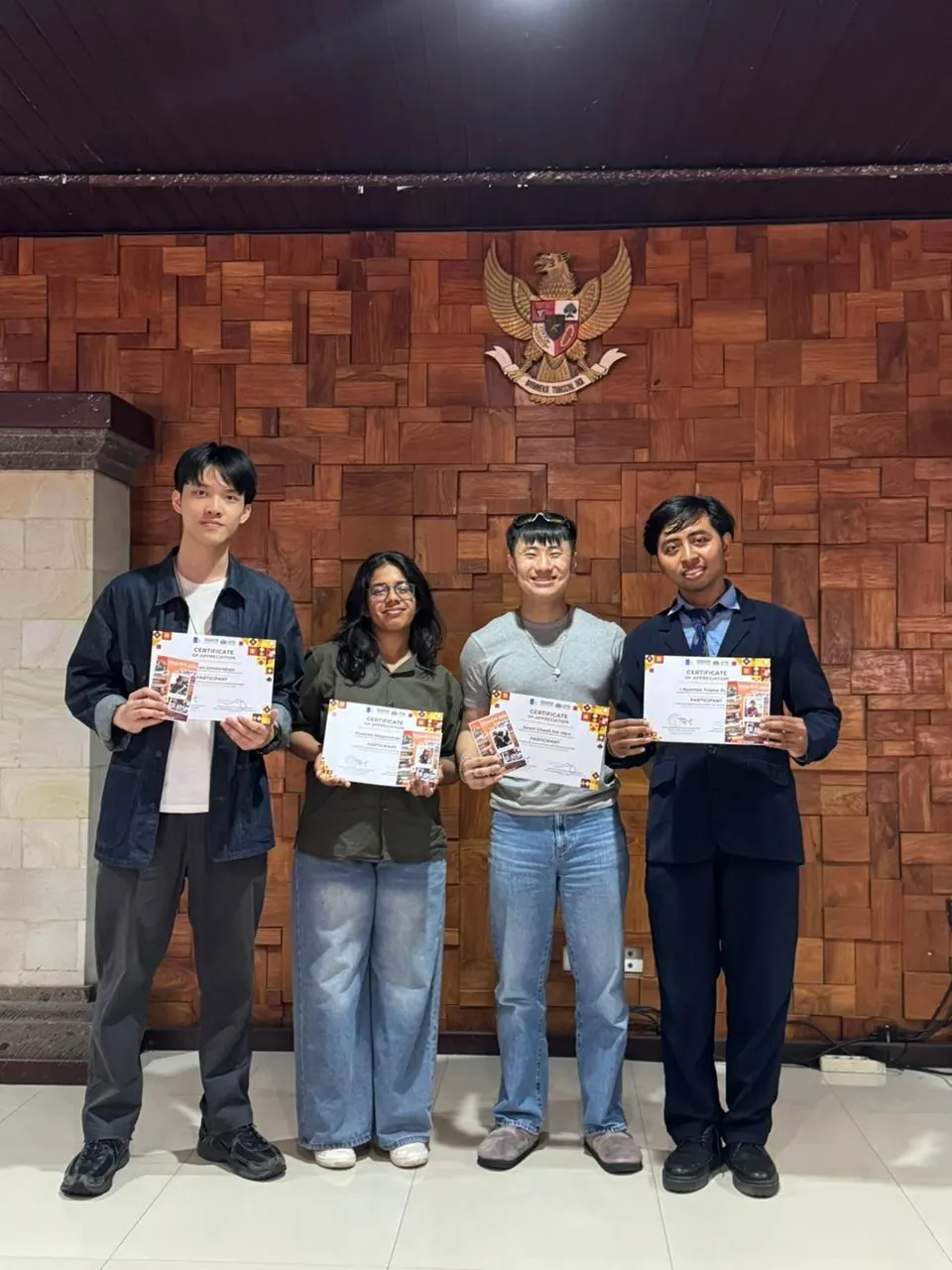
The end of it, certificates and all.

04 · The critique

What I would change about it

I was asked for an honest evaluation and gave one. It belongs here too.

The pace

All of the curriculum was worth having; there was simply too much of it for a fortnight, and the compression cost comprehension. My group was seated at the back, which meant I could not read the slides and spent teaching time photographing them with my camera zoomed in so I could read them later. Releasing the slides in advance would have removed that entirely. It is a small logistical detail that quietly taxed every session.

The industry visits

These were the strongest raw material and the thinnest use of it. We arrived, asked the questions our canvas needed filling, and left. Longer visits with some structured content about how the company actually runs — the common strategies, the trade-offs, the things a firm only tells you if you ask the right question — would have turned a data-collection exercise into an education.

The room

Passing a ball between groups to pick who answers next did work, and I would keep it. But the instructor-to-student interaction was otherwise thinner than the material deserved.

Why this section exists

A page that only records what went well is half a record. The programme was genuinely good — I would go again — and it had specific, fixable problems. Holding both of those at once is the thing I would want a colleague to be able to do, so it seems fair to do it here.

The seminar room photographed from the back rows, the projected slide small and hard to read at that distance
The view from the back rows — this is the photograph, taken to read the slide later.
A wider view of the same room during a session, the screen distant from the rear seating
Same room, same problem: the content was fine, the sightline was not.
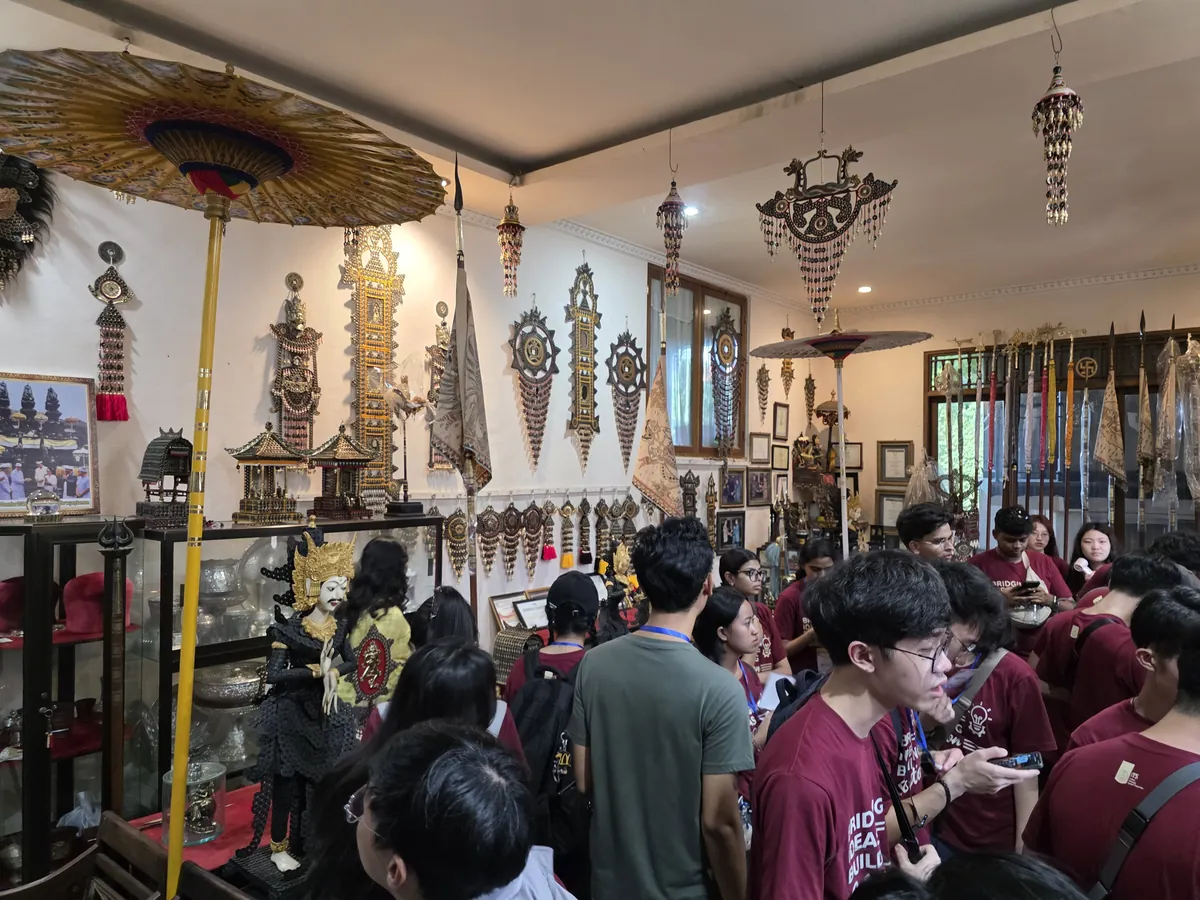
The cohort inside a workshop of Balinese ceremonial craft during an industry visit
An industry visit: we arrived, asked what the canvas needed, and left. The room deserved longer.
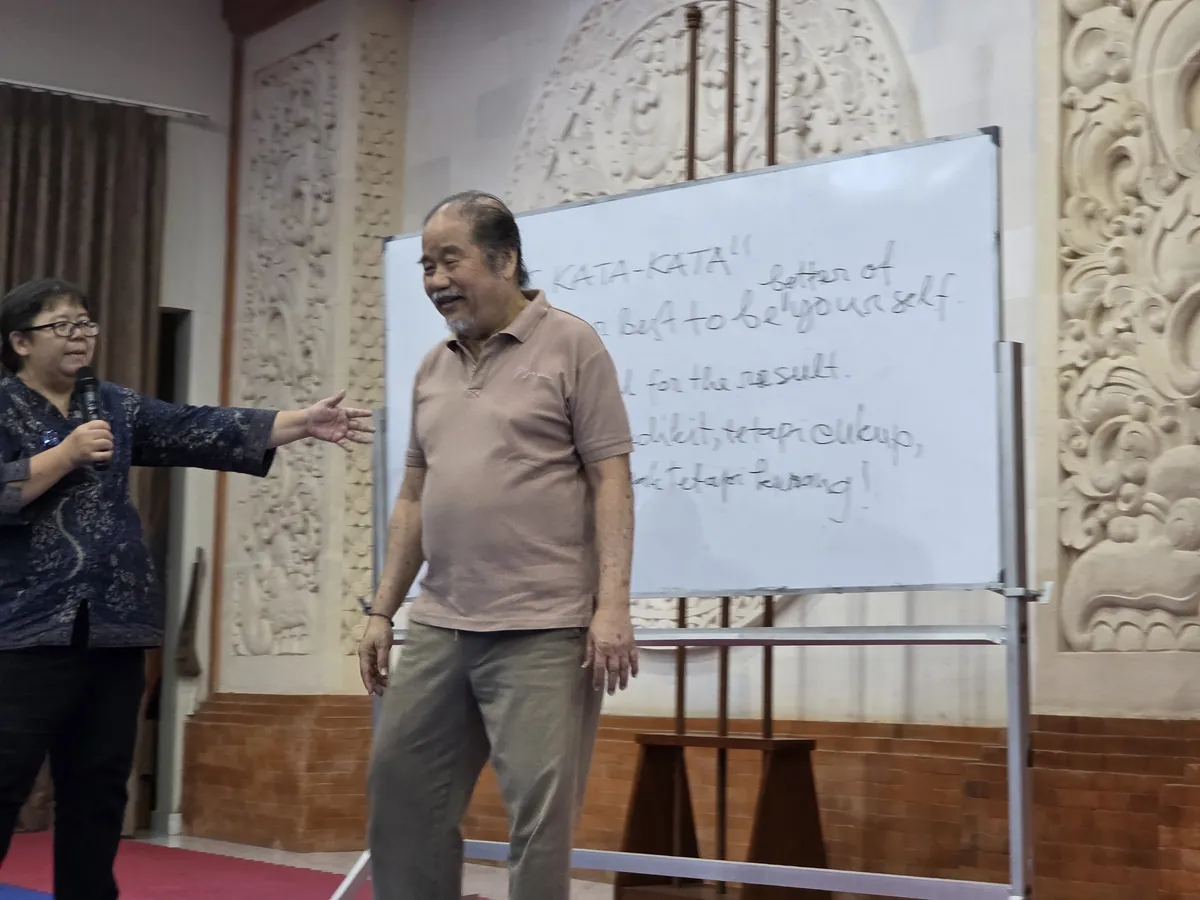
A host addressing the group beside a whiteboard written in a mixture of Indonesian and English
Decades of trade in the room, and a whiteboard in two languages. The material was there.

05 · The weekend

Mount Batur, at an hour no one volunteers for

The part of the fortnight that was not on the timetable, and taught me the most about the place.

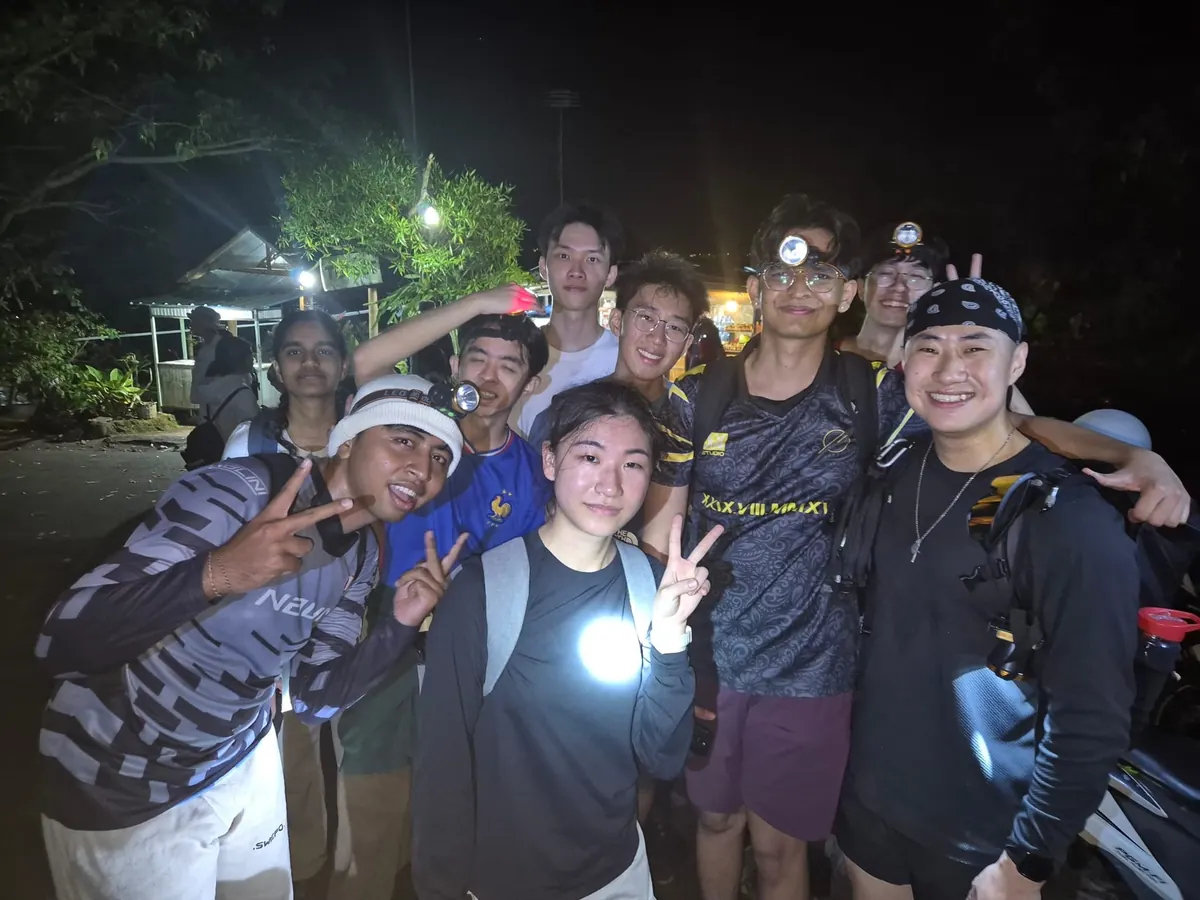
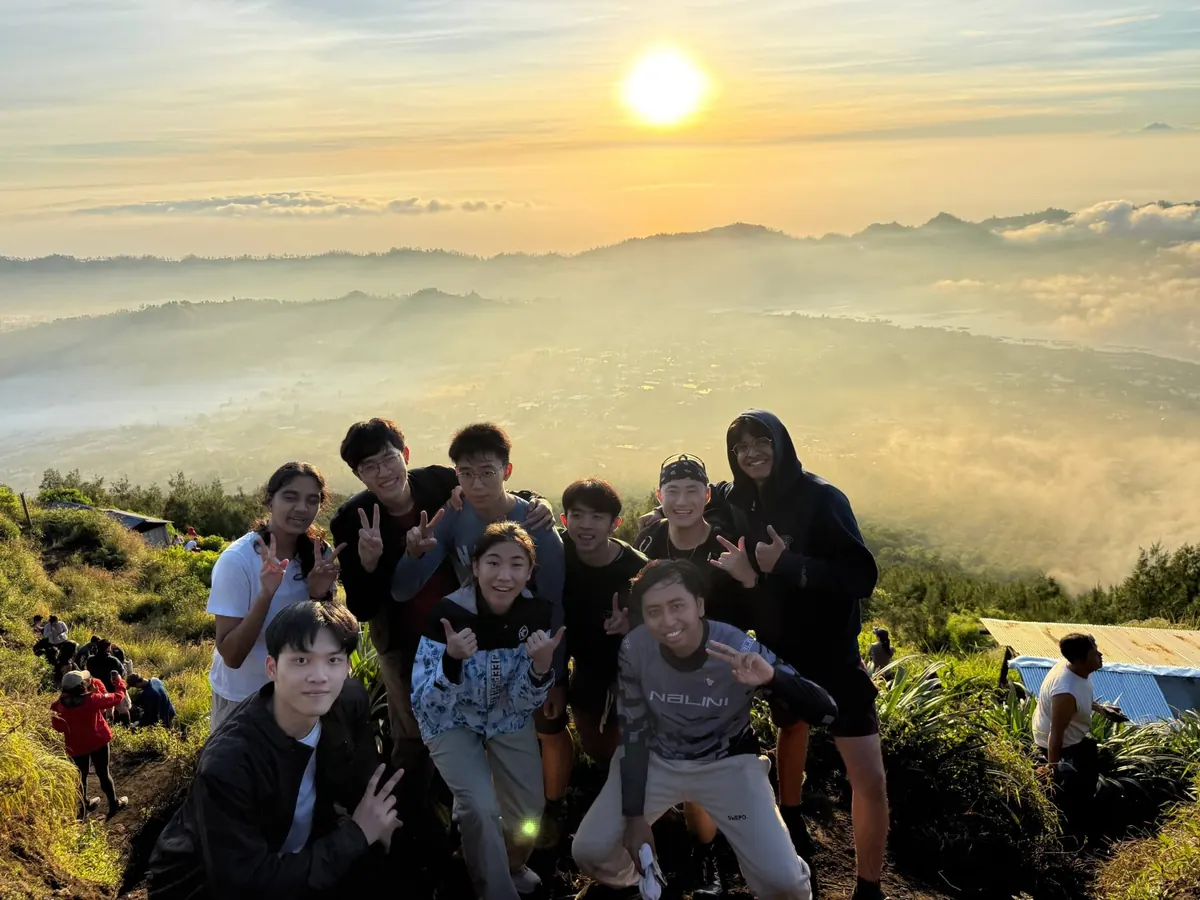
On the free weekend a group of us climbed Mount Batur, setting off in the dark with head torches to reach the top before sunrise. Locals and students together, most of us underslept, none of us dressed correctly for the temperature at altitude.

Why it belongs on this page

Because it was the part where I stopped being a student on a programme. Six hours of walking with people who actually live there produced more shared laughing, and more unguarded conversation about how the island really works, than any scheduled session did. Things get said on a dark path that do not get said in a seminar room.

What I took away

I arrived confident that being Indonesian meant I understood Balinese culture well enough. I did not, and the weekend was where that became obvious rather than arguable. That finding was worth more to me than the grade — it set the ceiling on how much I now trust my own sense of already knowing a place.

Setting off before dawn with head torches for the Mount Batur climb
Starting well before dawn, which is the only way to be up there in time.
Partway up the mountain before sunrise, the lights of the towns below still on
Partway up, with the lights of the towns below still on.
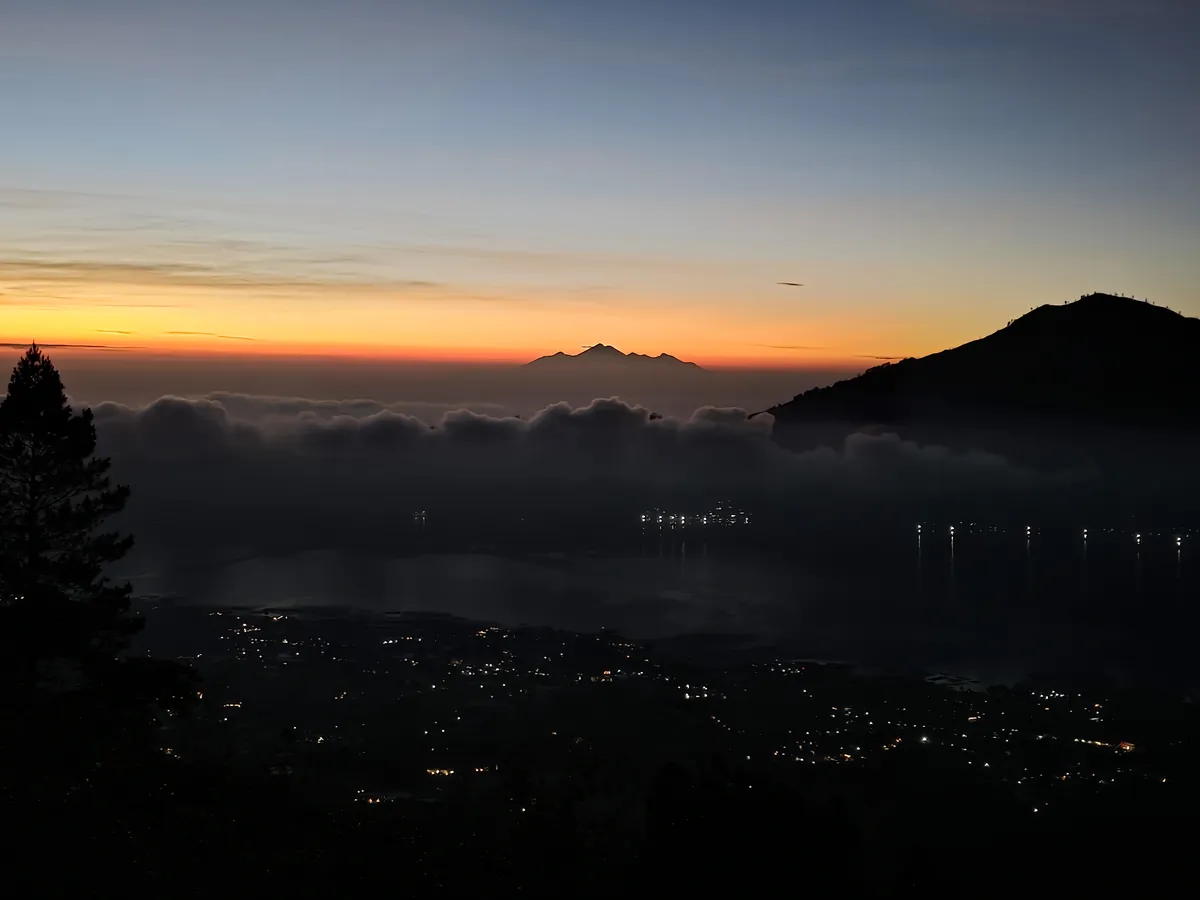
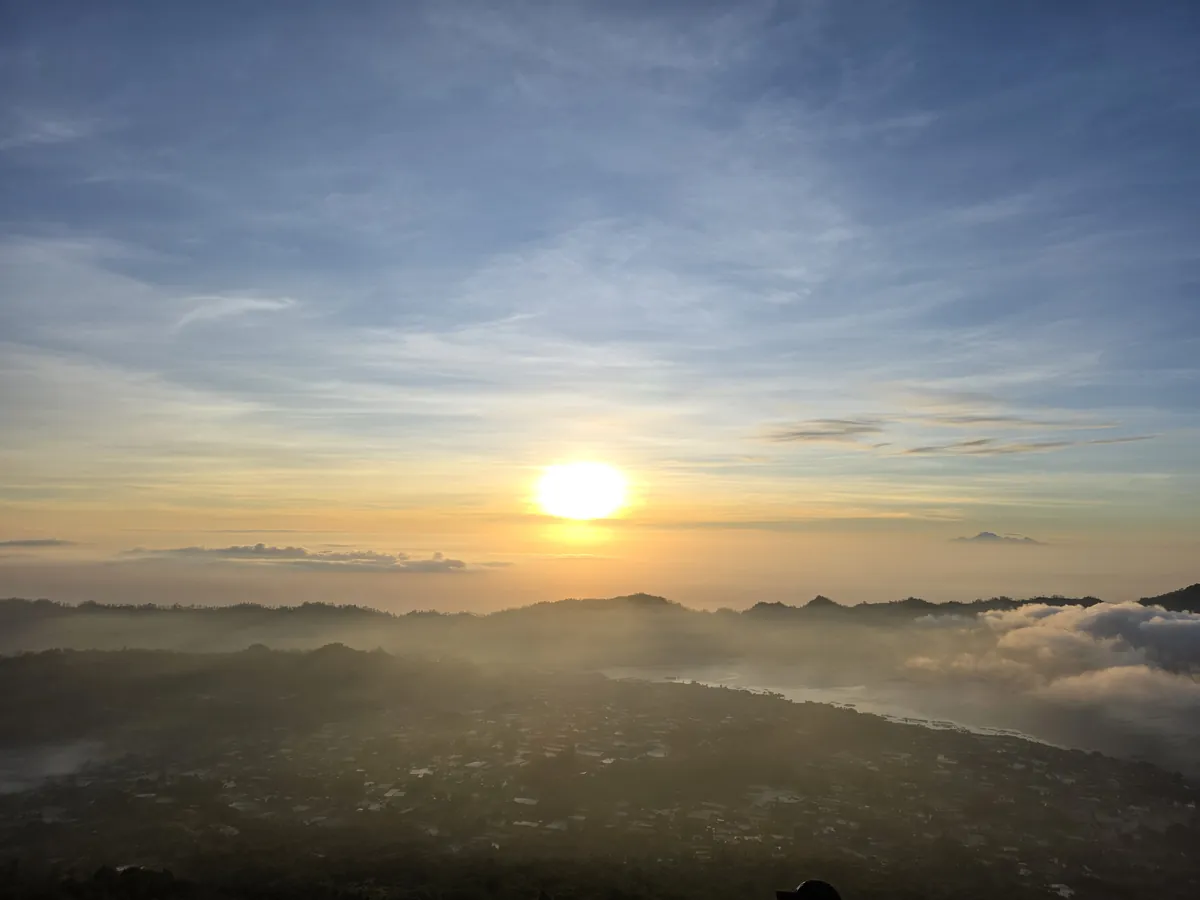
The sun rising above a layer of cloud seen from the mountain
The sun clearing the cloud layer.
At the summit of Mount Batur at sunrise with the rest of the group
The top, and the reason for the hour.

Where next

The argument for going

I would like to work somewhere else in ASEAN, or in China — Wenzhou most of all, for its reputation as the country's capital of private enterprise. The reasoning is not romantic. Business and entrepreneurship can be read about from anywhere; what cannot be read about is how a place actually conducts itself day to day, and that only comes from living in it for long enough to stop noticing that you are a visitor.

Bali also taught me that the ceiling on this is higher than I assumed. I went in confident I understood Balinese culture well enough as an Indonesian. I did not, and finding that out was the most useful thing that happened.