About
What about myself?
Hello again. My name is Johan Untawidjaja, and the short version is this: I was born in Singapore, grew up in Indonesia, and have now come back to Singapore to study engineering — which, if you squint, is a fairly long way to travel in order to end up where I started.
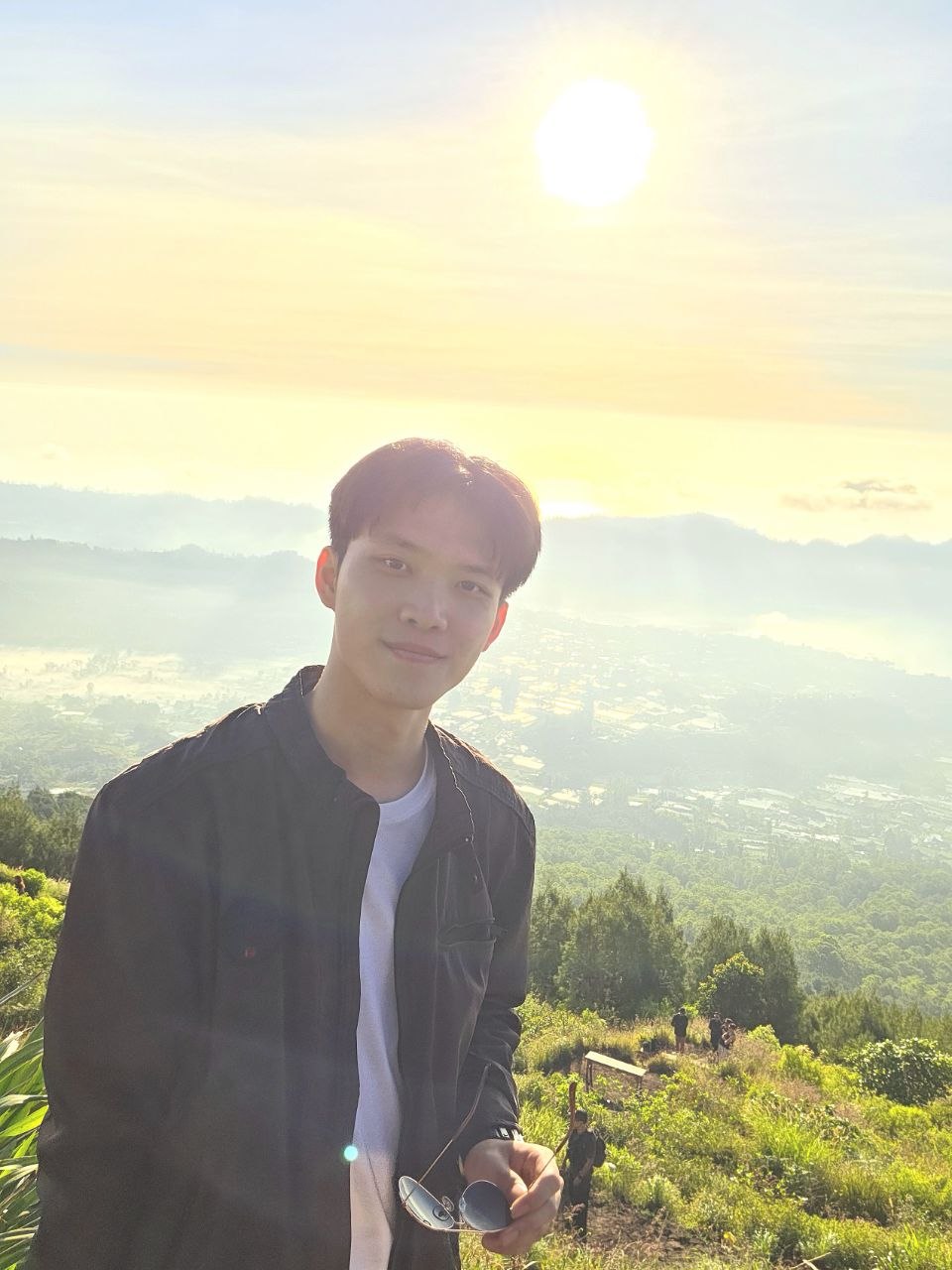
Mount Batur, Bali — 04:00 start, and worth every minute of it.
Taken during DIVE 2026 with Institut Teknologi Sepuluh Nopember.
Where I come from
I spent most of my life in Indonesia, where the clock seems to tick slower than anywhere else in the world. I have always credited that to the surroundings — the warm breeze, the trees moving against each other, and an orange sunset arriving at almost exactly the same hour every evening. It is a good place to think slowly, and I did a great deal of that.
Both of my parents are entrepreneurs with backgrounds in accounting, which is probably why I find numbers reassuring rather than intimidating. Growing up, a spreadsheet was not an abstraction; it was a household object. That inheritance shows up in odd places — it is the reason my first properly deployed product was a financial tool, and the reason I care whether a prototype could ever pay for itself.
What I study
I read Engineering Product Development at the Singapore University of Technology and Design, on an ASEAN Undergraduate Scholarship. My Freshmore terms carried me through design thinking, physical and technological systems, modelling and analysis, design computation, data-driven modelling, uncertainty, energy systems — and, unexpectedly, urban sketching, which turned out to be the course that most changed how I look at an object before I draw it.
Before that I completed the Pearson Edexcel A-Levels, with an A in Mathematics, Physics and Chemistry. Those three are not a coincidence. They are the subjects I would have chosen even if nobody were grading them.
How I think
In physics and chemistry, I can picture how particles sit and interact, and how that accumulates into the world we actually walk around in. In mathematics, I can take something abstract and pin a number to it, which is the only honest way I know to tell whether a thing is getting better or merely getting different. Most of my notebooks are diagrams in far too many colours.
Music
I have perfect pitch, which is less impressive than it sounds and more useful than it looks. I play piano, guitar and bass, and inside the SUTD Chinese Orchestra I play dizi, zhongruan, the Chinese drums, and the double bass — the last of which I learned from nothing to concert standard within a single term, under a mentor who was considerably more patient than the situation warranted.
I became President of the orchestra in March 2026, after running marketing for our TENacity concert. The role is less about performing than people usually assume: it is budgets, sponsorship, procurement, and making sure a room of musicians has somewhere to be on a Thursday.
Photography, and everything else
I photograph constantly, and most of the images on this site are mine. It earned me the Judge's Choice Artwork at my school's art exhibition and a place representing the school at FL2SN — but mostly it earns me a reason to keep looking at things properly. Outside of that: badminton, football, the occasional game of pool (the table kind, not the swimming kind), and an unapologetic family habit of hunting down new restaurants.
How I work
I treat AI as a teammate rather than a vending machine. That means writing the specification first and directing the tool against it, instead of improvising prompt by prompt — and then reviewing whatever comes back as I would review a colleague's contribution. On my last build, the tool reported three defects to me; I read the source, disproved two of them, and fixed the one that was real.
The habit underneath all of it is the same one the doorbell taught me: the version that fails tells you considerably more than the version that works. I would rather find out early, in a workshop, than late, in front of a room.
Get in touch
I am currently looking at global innovation internships, exchange placements, and engineering internships where a product has to survive an actual user. If that sounds like something you are running, I would like to hear about it.